Senate Bill 413 – OOR Testimony

Open records_logo stackedSenate Bill 413, introduced by Senator Rich Alloway, would extensively revise provisions related to the practice and procedure of Commonwealth agencies, establish the Office of Administrative Hearings, and extensively revise provisions on judicial review of Commonwealth agency action.

The Senate State Government Committee, chaired by Senator Mike Folmer, held a public hearing this week on SB 413.

I provided this written testimony to the committee, emphasizing the unique nature of the Office of Open Records — that the vast majority of our cases involve people who are not represented by an attorney. As established in the Right-to-Know Law, the OOR’s appeal process was always intended to be simple, inexpensive, and relatively quick.

Senate Bill 413 – Written Testimony

Social Media and the RTKL

Open records_logo stackedTo date, few appeals made to the Office of Open Records have involved social media. In one recent case, Davis v. City of Butler Police Department, the requester sought the following social media records (the request has been lightly edited for clarity):

  1. All posts made by users to the Butler City Police Department and Butler City K9 Fundraiser Facebook pages between Feb. 6, 2016, and Feb. 12, 2016.
  2. A list of all personnel who operate the Butler City Police Department Facebook page, including full name, salary, and date of hire.
  3. A list of all users who have been blocked from the Butler City Police Department Facebook page.

The OOR found that the Police Department demonstrated that no responsive records exist regarding the first item. During the appeal, the Department provided the requester with records responsive to the second item.

As to the third item, the OOR directed the Department to provide a screenshot of its Facebook page indicating whether any banned users were listed.

The Department provided the screenshots, but also said in its filing that “it is outside [the OOR’s] authority to direct [the Department] to compile records that are not maintained in the ordinary course of business.” See 65 P.S. § 67.705. The OOR held that the Department did not create or compile a record when it provided the OOR with the requested screenshot from its Facebook page; rather, it produced information from a database which was created by and is under the direct control of the Department.

I predicted in our 2015 Annual Report that the OOR will face more issues involving social media records. This case is a good example.

5 Top Appellate Court Decisions in 2015

Every year, dozens of RTKL cases are decided by the Supreme Court, Commonwealth Court, and county Courts of Common Pleas.

Here, in no particular order, are five of the most significant decisions from 2015.

Pa. Dep’t of Education v. Pittsburgh Post-Gazette
119 A.3d 1121 (Pa. Commw. Ct. July 14, 2015)
When the specificity of a request is at issue, Commonwealth Court uses a three-part balancing test, “examining the extent to which the request sets forth (1) the subject matter of the request; (2) the scope of documents sought; and (3) the timeframe for which records are sought.”

Pa. Office of Attorney General v. Phila. Inquirer
127 A.3d 57 (Pa. Commw. Ct. Nov. 19, 2015)
The RTKL’s definitions of “record” and “public record” were examined. Commonwealth Court held that “[t]he fact that [emails] were sent, received or retained in violation of OAG policy does not transform what was not a public record into a public record under the RTKL. For emails to qualify as records ‘of’ an agency, we only look to see if the subject-matter of the records relate to the agency’s operations.”

Pa. Dep’t of Labor & Industry v. Earley
126 A.3d 355 (Pa. Commw. Ct. Sept. 9, 2015)
Regarding email records, Commonwealth Court held that “When an individual deletes an email from his or her email account … that does not mean that the email is necessarily deleted. Those emails remain on the mail server until they are deleted in accordance with a retention schedule. … [T]o establish that the email records do not exist, the Department must also establish that they no longer exist on the mail server.”

Pa. State Police v. Grove
119 A.3d 1102 (Pa. Commw. Ct. July 7, 2015)
Video recordings made by police car dashcams (a.k.a. mobile video recordings, or MVRs) are not inherently investigative records, although they may include investigative information which needs to be redacted: “The mere fact that a record has some connection to a criminal proceeding does not automatically exempt it under Section 708(b)(16) of the RTKL or CHRIA. … PSP is entitled to redact the portions of MVRs that contain actual investigative information … but may not withhold an entire MVR on the basis that part of it is investigative.” (NOTE: This case is now pending in the Supreme Court.)

Pa. State Police v. Muller
124 A.3d 761 (Pa. Commw. Ct. June 30, 2015)
Reinforcing the need for agencies to provide evidence when a case is before the OOR, Commonwealth Court held that “[a]n agency is not entitled to ignore its burden to show an exemption from disclosure before OOR and rely on supplementation of the record in this Court to avoid the consequences of that conduct.”

Other significant cases from 2015 — and previous years — are available on the OOR website.

10 Examples of Records the RTKL Provided Access to in 2015

Here’s a sampling of the types of records which the Right-to-Know Law provided access to in 2015:

  1. Information regarding airport perimeter security breaches at Philadelphia International Airport and Northeast Philadelphia Airport.
  2. The amount spent on school district solicitor bills and other legal expenses over the course of a fiscal year at numerous school districts.
  3. A redacted copy of the Pennsylvania State Police After Action Report / Improvement Plan issued following the September 2014 shooting at the Blooming Grove barracks.
  4. De-identified information about the waiting lists for service at Norristown State Hospital, Torrance State Hospital, and other regional forensic psychiatric center facilities.
  5. Training records for a police officer charged (and later acquitted) in a fatal shooting.
  6. Emails related to discussions about where school crossing guards should be assigned after a girl was killed trying to cross at a busy intersection.
  7. The amount paid to settle a federal lawsuit filed by a woman who claimed her son was wrongly killed by a state trooper and, separately, the amounts paid to defend and settle a wrongful termination lawsuit brought by a former public defender.
  8. Information revealing that about 10 percent of school employees in a particular district were related to the district’s top officials.
  9. Emails indicating that local officials were using official email accounts for communication related to local elections.
  10. A log of reports of health complaints tracked by the Department of Health in areas of the state seeing natural gas development.

The complete Office of Open Records 2015 Annual Report is available on our website (along with previous years).

Local Appeals in 2015 on a County-by-County Basis

Philadelphia is the state’s most populous county (and city), so it doesn’t come as a surprise that Philadelphia agencies were involved in more local appeals than those in any other county. The top 5 also included Allegheny, Montgomery, Dauphin, and Luzerne counties.

The first map below shows the number of non-inmate appeals involving local agencies which were filed with the OOR in 2015. (All local agencies — e.g., county government, school districts and municipalities — are included in each county total.)

CountyMapTotal

But… it might come as a surprise that Carbon County was at the top of the list in terms of per capita* appeals filed in 2015. The top 5 also included Dauphin, Elk, Cambria, and Luzerne counties.

The map below shows the number of non-inmate appeals involving local agencies filed with the OOR in 2015 per 100,000 population. (All local agencies — e.g., county government, school districts and municipalities — are included in each county total.)

CountyMapPerCapita

* To be precise, per 100,000 population based on 2014 U.S. Census Bureau Population Estimates.

The complete Office of Open Records 2015 Annual Report is available on our website (along with previous years).

EDITED TO ADD (March 18, 2016, at 10:12 a.m.):

These maps illustrate workload; the data doesn’t necessarily correlate to the quality of agency responses within a given county. There are many factors to consider in evaluating agency responses and determining why a given number of appeals were filed. For example, it’s quite possible that one or two incidents could spike the number of requests (and potentially appeals) at a given local agency. Also, larger population areas tend to have more requests filed, often with more nuanced issues involved.

Finally, I note that the Office of Open Records has no way of knowing how many appeals are simply granted by agencies. That data is not collected on a statewide basis.

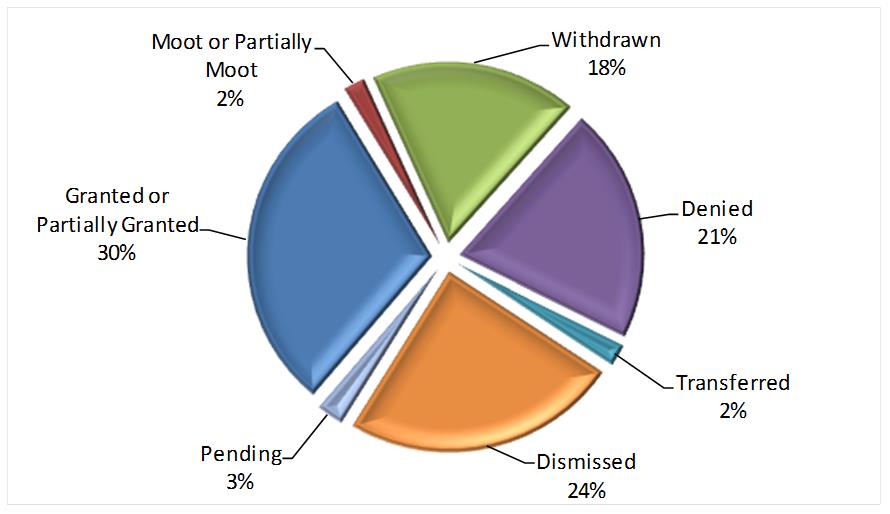
873 Appeals Granted, Withdrawn or Found Moot in 2015

Appeals filed with the Office of Open Records can be grouped into six categories:

  • Granted
  • Withdrawn
  • Moot
  • Denied
  • Dismissed
  • Transferred

Requesters obviously gain access to records when appeals are granted. Less obvious is that they often gain access when appeals are withdrawn (only the requester can withdraw an appeal) or found to be moot (usually because records were provided during the appeal).

The most common reason appeals are dismissed is that they’re filed too early or too late. (Appeals filed too early can be refiled.) Appeals are transferred when the OOR isn’t the proper venue for an appeal (e.g., appeals involving a judicial office or statewide row office ).

The pie graph below shows the results of all non-inmate appeals filed in 2015 as of March 1, 2016.

AppealsGrantedNonInmate

The complete Office of Open Records 2015 Annual Report is available on our website (along with previous years).

1,794 Appeals Involving Local Agencies in 2015

61.3% of the appeals filed with the OOR in 2015 involved local agencies.

Among local agencies, municipal governments (cities, boroughs, and townships) were involved in the most appeals last year: 36%. If you include local police and fire departments, that percentage jumps to 58%.

Counties were involved in 21% of local agency appeals. School districts (8%) and charter schools (6%) combined for 14%.

AppealsFiledLocalAgencies

The complete Office of Open Records 2015 Annual Report is available on our website (along with previous years).

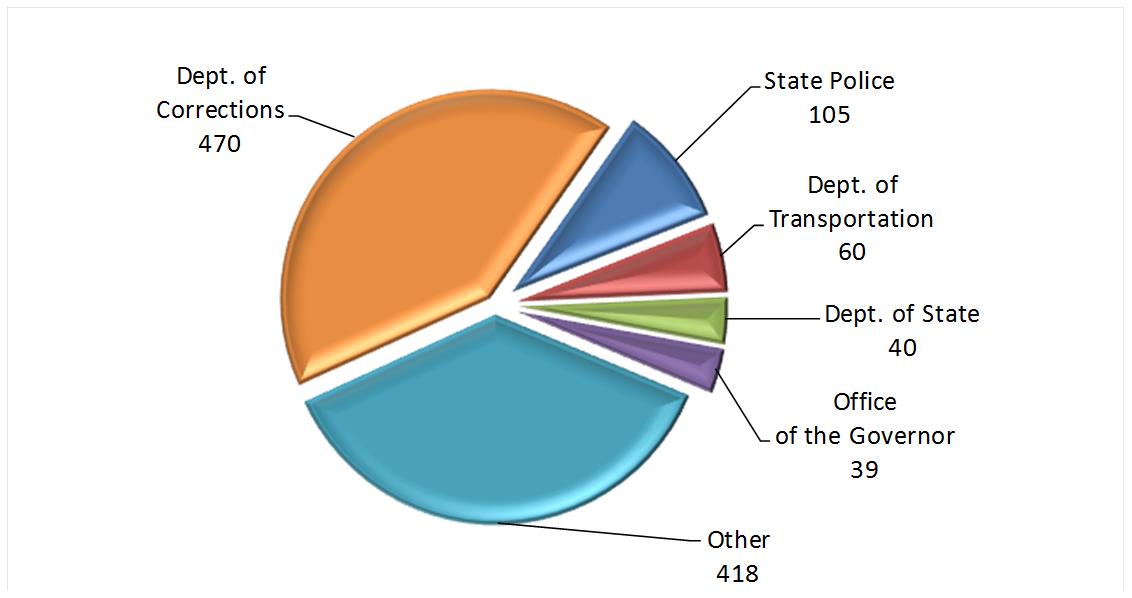
1,132 Appeals Involving State Agencies in 2015

38.7% of the appeals filed with the OOR in 2015 involved state agencies.

Once again, the Department of Corrections (41.5%) was involved in more appeals than any other state agency. The vast majority of appeals involving DOC were filed by inmates.

The State Police were involved in 9.2% of state agency appeals, followed by the Dept. of Transportation (5.3%), the Dept. of State (3.5%), and the Governor’s Office (3.4%).

AppealsFiledStateAgencies

The complete Office of Open Records 2015 Annual Report is available on our website (along with previous years).

1,414 Appeals Filed by Inmates in 2015

For the first time ever in 2015, inmates (48%) filed more appeals with the OOR than any other requester group. The previous high was 41%, set in 2013.

In 2015, citizens filed 39% of appeals, companies 8%, media outlets 5%, and government officials 0.3%.

Senate Bill 411, currently pending in the House State Government Committee, would limit inmate requesters to 11 specific categories of records, such as the inmate’s work, financial, educational, tax, voting, and disciplinary records, policies adopted by the correctional institution or the Department of Corrections, and criminal records relating to the criminal commitment of the inmate.

AppealsFiledByCategory

The complete Office of Open Records 2015 Annual Report is available on our website (along with previous years).

2,926 Appeals Filed with the OOR in 2015

As part of Sunshine Week, the Office of Open Records released its Annual Report for 2015. This post and the next several will take a look at some of the information included in that report.

The Office of Open Records officially opened its doors on January 1, 2009. In the first full year of operation, 1,155 appeals were filed. In 2015, that number was more than 250% higher.

In fact, 2015 was the busiest year ever — by far — for the OOR. The total of 2,926 appeals eclipsed the previous record of 2,478 appeals filed in 2013.

Beyond the numbers, the complexity of cases before the OOR also increased significantly in 2015. As both requesters and agencies gain experience with the RTKL, and as the body of case law develops, appeals tend to present more complicated and nuanced issues for the OOR to decide.

AppealsFiledByYear

The complete Office of Open Records 2015 Annual Report is available on our website (along with previous years).