IUP Journalism Class

IUP LogoYesterday, I had the privilege of speaking to a journalism class at Indiana University of Pennsylvania.

Dr. David Loomis invited me to talk to the class about the Right-to-Know Law, the Sunshine Act, and other issues of government transparency.

The class had a lot of great questions, and the discussion was a lot of fun.

Here’s the Powerpoint I put together for the event:

Indiana University of Pennsylvania Presentation 24 Sept 2015 (PDF)
Indiana University of Pennsylvania Presentation 24 Sept 2015 (PPTX)

OOR Annual Training: 10/21 in Harrisburg

The Office of Open Records conducts training sessions across Pennsylvania throughout the year, but each year we also host an Annual Training session in Harrisburg. This year’s event will take place on Wednesday, Oct. 21, from 10 a.m. to 12 p.m., at the State Museum.

This training session will cover both the Right-to-Know Law (also known as the Open Records Law) and the Sunshine Act (also known as the Open Meetings Law), including a discussion of significant recent OOR rulings and court decisions impacting the laws. Attendees will have ample opportunity to ask questions.

Registration is free, and the event is pending approval for 1.5 CLE credits.

Register online at http://oor-training-2015.eventbrite.com/

UPDATE (9/25): The training has been approved for 1.5 CLE credits.

Thrival Festival: Big Data & You

Yesterday, I took part in the “Big Data & You” panel at Pittsburgh’s Thrival Innovation & Music Festival.

The panel also included Dr. Rasu Shrestha, Chief Innovation Officer, UPMC Enterprises; Dr. Amesh Adalja, Senior Associate, UPMC Center for Health Security; and Saman Haqqi, President of Pittsburgh Dataworks and Program Director at IBM’s Watson Group. Our terrific moderator was Jay Srini, Chief Information Officer, Kew Group.

It was a fascinating discussion and I was excited to be a part of it. Here’s the Powerpoint I used:

Thrival Festival Presentation 22 Sept 2015 (PPTX)
Thrival Festival Presentation 22 Sept 2015 (PDF)

Yesterday’s other panels and discussions were equally interesting, including “This is Old News: Innovation in Traditional Media” and “Creative Chaos: Diversity and Innovation.” If you’re in the Pittsburgh area this week, check out Thrival Festival’s schedule. This year’s event runs through Sunday, Sept. 27.

Follow ErikOpenRecords and OpenRecordsPA on Twitter.

New Office of Open Records Website

I’m pleased to report that the Office of Open Records has a brand new website: http://www.openrecords.pa.gov/

It’s designed to make it easier for everyone — requesters, agencies, media, etc. — to access the information they need as quickly as possible.

The website will always be a work in progress, so if you have an idea for improvement, let us know! Leave a comment here, tweet @ErikOpenRecords or @OpenRecordsPA, or send an email to openrecords@pa.gov.

Agency Open Records Officer Guidebook

The Office of Open Records website (which, by the way, is scheduled to get a much-improved look and feel tomorrow!) includes numerous guides about the Right-to-Know Law for both requesters and agencies.

The newest — and most comprehensive — of these is our new Agency Open Records Officer Guidebook (PDF).

The AORO Guidebook, 79 pages in total (with a variety of sample forms agencies can use as templates), is designed to provide a general overview of the RTKL process from an agency perspective. We tried to write it to be helpful for both new and veteran AOROs.

If you have any comments or suggestions, please post them here or tweet to @ErikOpenRecords or @OpenRecordsPA. You can also email us at openrecords@pa.gov.

OOR on Yelp

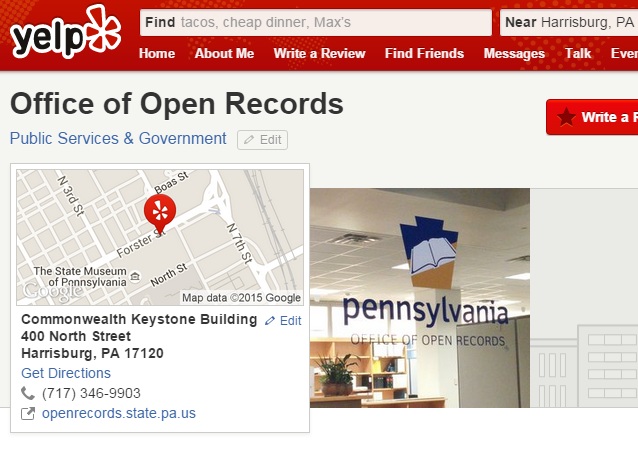
OOR on YelpThe Office of Open Records is now on Yelp, the online review site.

Inspired by the article “Can Yelp Help Government Win Back the Public’s Trust?,” published this week by Governing, I added the OOR to Yelp this morning. Here’s part of what the article had to say:

Last month, Yelp and the General Services Administration (GSA), which manages the basic functions of the federal government, announced that government workers will soon be able to read and respond to their agencies’ Yelp reviews — and, hopefully, incorporate the feedback into service improvements. …

“I think government is looking to become far more innovative when it comes to social media,” said Laurent Crenshaw, head of public policy for Yelp. “This agreement provides a new way to connect with citizens and improve services.”

The goal of adding the OOR to Yelp is to give the public another way to connect with us, specifically to let us know how we’re doing. So if you’ve ever had a chance to interact with the OOR, go ahead and post a review. We want to hear from you!

August 2015 Appeals Statistics

August was another record-breaking month here at the Office of Open Records. More appeals came in our door last month than in any month before.

We received 344 appeals in August. At this point, four of the top five months in history (including each of the top three) have been in 2015.

Here’s a look at the top 10 busiest months in the history of the OOR:

  1. Aug. 2015 — 344 appeals received
  2. June 2015 — 313
  3. July 2015 — 261
  4. Sept. 2013 — 244
  5. April 2015 — 241
  6. Oct. 2013 — 240
  7. Aug. 2013 — 235
  8. Aug. 2012 — 231
  9. April 2013 — 222
  10. Dec. 2013 — 221

Photographing Public Records

On Aug. 14, the Office of Open Records issued a decision — Muenz v. Township of Reserve — which holds that requesters can photograph public records which they asked to inspect.

Following is the entire relevant section of the Muenz Final Determination (FD):

***

The Requester argues that the Township did not permit photographs of responsive records to be taken. Specifically, the Requester asserts that while inspecting the requested records, upon attempting to photograph documents, he was informed by the Township police chief that he would be permitted to pay for copies of the records but that he would not be able to take photographs. The Township does not dispute these facts and argues that there is no provision in the RTKL that requires the Township to permit the Requester to photograph of records.

Section 701(a) of the RTKL requires that public records be accessible for inspection and duplication. 65 P.S. § 67.701(a). Agencies, under the RTKL, may adopt “regulations and policies necessary for … [agencies] to implement” the RTKL. See 65 P.S. § 67.504(a). In Gries v. Philadelphia City License Marriage Bureau, the OOR upheld an agency’s policy of prohibiting requesters from photographing copies of records where the agency’s fee policy was governed by a statute other than the RTKL. OOR Dkt. AP 2009-0552, 2009 PA O.O.R.D. LEXIS 660. In Wright v. Department of Corrections, the OOR held that, pursuant to an agreement between a requester and an agency, the agency was required to allow the requester “to bring his own copier or scanner.” OOR Dkt. AP 2009-0174, 2009 PA O.O.R.D. LEXIS 608.

This matter is distinguishable from Gries in that here there is no evidence that the Township is permitted by statute to impose a fee schedule separate than that set by the OOR. See 65 P.S. § 67.1307(g) (“Except as otherwise provided by statute, no other fees may be imposed unless the agency necessarily incurs costs for complying with the request, and such fees must be reasonable.”) In Gries, a separate statute set the fee schedule for the agency, in addition to authorizing the agency to set fees not expressly provided for by statute. As part of its statutory obligations, the agency adopted a policy prohibiting the use of photography.

Section 1307 of the RTKL addresses duplication, providing that “[a]n agency may waive fees for duplication of a record, including, but not limited to, when: … the requester duplicates the record[.]” 65 P.S. § 67.1307(f)(1). Therefore, the RTKL contemplates situations in which requesters themselves duplicate records, rather than seeking duplication by the agency. Photographing a document is a form of duplication and, therefore, is permissible under the RTKL. Allowing an agency which lacks separate statutory authority to set a fee schedule prohibiting the photographing of documents would be contrary to the purpose of the RTKL, which is “to maximize access to government records.” See Gingrich v. Pa. Game Comm’n, No. 1254 C.D. 2011, 2012 Pa. Commw. Unpub. LEXIS 38 at *16 (Pa. Commw. Ct. 2012). To hold otherwise would not only permit agencies to allow the public to inspect public records, but would also, following the reasoning to its logical conclusion, permit agencies to prohibit the public from taking written notes about public records or recording an audio dictation describing public records. Such an interpretation of the RTKL would lead to an absurd and unreasonable result, and cannot be said to have been the intention of the General Assembly. See 1 Pa.C.S. §1922. Therefore, under Section 701(a) of the RTKL, the Township must make responsive records available to the Requester for his inspection and duplication by photography.

***

Here’s the bottom line:

Under the Right-to-Know Law, agencies cannot charge requesters who wish to use their own equipment, such as a smartphone, to photograph public records which they asked to inspect.

Note: Because the OOR’s FD granted in part and denied in part, either party can appeal this decision to the Allegheny County Court of Common Pleas within 30 days.

July 2015 Appeals Statistics

In June, the Office of Open Records received more appeals than in any previous month. We didn’t break that record in July, but we did receive the second-most appeals ever.

We received 261 appeals in July, which means three of the top four months in history have been in 2015.

Here’s a look at the top 10 busiest months in the history of the OOR:

  1. June 2015 — 313 appeals received
  2. July 2015 — 261
  3. Sept. 2013 — 244
  4. April 2015 — 241
  5. Oct. 2013 — 240
  6. Aug. 2013 — 235
  7. Aug. 2012 — 231
  8. April 2013 — 222
  9. Dec. 2013 — 221
  10. July 2013 — 220

Edited on Aug. 17, 2015: The number of appeals filed in July was 261, not 264. Three appeals filed in August has mistakenly been attributed to July.