Social Media and Pennsylvania’s Right-to-Know Law

Open records_logo stackedAs agencies across Pennsylvania use social media more often to communicate with residents, Right-to-Know Law (RTKL) requests for records related to social media are becoming more common.

Determining whether information related to social media — including social media posts, direct messages sent via social media, and other types of information — qualifies as a “record” or a “public record” under the RTKL is no different than determining whether an email, a memo, or a map is a “record” or a “public record.”

First, agencies should determine whether a request is seeking a record, defined as “information … that documents a transaction or activity of an agency…”

If the request is seeking a record, agencies should determine whether it is a public record, defined as “A record, including a financial record, … that (1) is not exempt under Section 708, (2) is not exempt … under any other Federal or State law or regulation or judicial order or decree; or (3) is not protected by a privilege.”

Examining some decisions from the Office of Open Records (OOR) and the Commonwealth Court may be useful. Here’s a look at several of the most significant decisions involving social media.

Boyer v. Wyoming Borough (OOR Dkt. No.: AP 2018-1110)

The request sought records related to the mayor’s Facebook page, including a list of page administrators and editors and all comments made and removed or blocked from the page.
Continue reading

Draft Update to Standard RTK Request Form

The Office of Open Records (OOR) is required by Pennsylvania’s Right-to-Know Law (RTKL) to “develop a uniform [request] form which shall be accepted by all Commonwealth and local agencies” (Section 505(a) of the RTKL).

We’ve developed a draft update to the Standard RTK Request Form and we want to know what you think. The goal is simple: Improve the form by making it more useful and easier to understand for both agencies and requesters.

Please take a look at the draft update, compare it to the existing form, and share any comments or suggestions by Sept. 30, 2018.

Note: When the update is finalized, the PDF version of the form will be a fillable PDF, just as the current form is. The draft version does not include that feature.

Draft Update to the Standard RTK Request Form – draft as of Sept. 13, 2018

Current Standard RTK Request Form – as of Sept. 13, 2018

Contact the OOR to share your thoughts

Podcast: Two RTKL Surveys

Podcast Logo CroppedThe fourth episode of the Open Records in Pennsylvania podcast is now available.

After a lengthy (far too lengthy) break, the podcast returns to discuss the results of two statewide surveys released earlier this year.

Links:
More about the OOR survey
More about the LBFC survey
Oct. 11, 2018, Requester Training
The Office of Open Records

Subscribe:
Open Records in Pennsylvania podcast on Apple Podcats / iTunes
Open Records in Pennsylvania podcast on Stitcher

To subscribe on other podcast apps, search for “Open Records in Pennsylvania” to find our feed.

Listen:

Download:
Episode 4 of the Open Records in Pennsylvania podcast

If you have ideas for future episodes of the podcast, I’d love to hear from you. Share your thoughts in the comments below, tweet to @ErikOpenRecords or @OpenRecordsPA, or send an email to openrecords (at) pa (dot) gov.

Presentation to Committee of Seventy Interns

Earlier this week, a group of interns from the Committee of Seventy visited the Office of Open Records in Harrisburg to discuss the Right-to-Know Law and the OOR.

It was a great discussion, and I very much appreciate them visiting. Here’s the presentation I used to help frame the discussion:

Committee of Seventy Interns – July 31, 2018 (PPTX)
Committee of Seventy Interns – July 31, 2018 (PDF)

54 Training Sessions in 2017

More than 1,900 people attended official Office of Open Records training sessions in 2017. We traveled the state again, including visits to Charleroi, Doylestown, Grove City, Pittsburgh, Roaring Branch, and Summerdale.

The OOR provides training on the Right-to-Know Law and the Sunshine Act.

We’re back on the road in 2018 — and this year we’ll also be conducting training sessions online.

Our training schedule can be found here.

This information is from the OOR’s 2017 Annual Report.

110 Mediations in 2017

The Office of Open Records conducted 110 Right-to-Know Law mediations in 2017.

Our mediation program can be an effective way to resolve disputes between requesters and agencies. Many of our Appeals Officers are also trained mediators and can conduct mediations via telephone or in person.

When a mediation is successful, the appeal is withdrawn — saving both sides the effort of engaging in a formal appeal process and ensuring that the case never goes to court.

Either side can choose to end mediation at any time; if this happens, the OOR’s traditional appeal process begins.

More about our mediation program can be found here.

This information is from the OOR’s 2017 Annual Report.

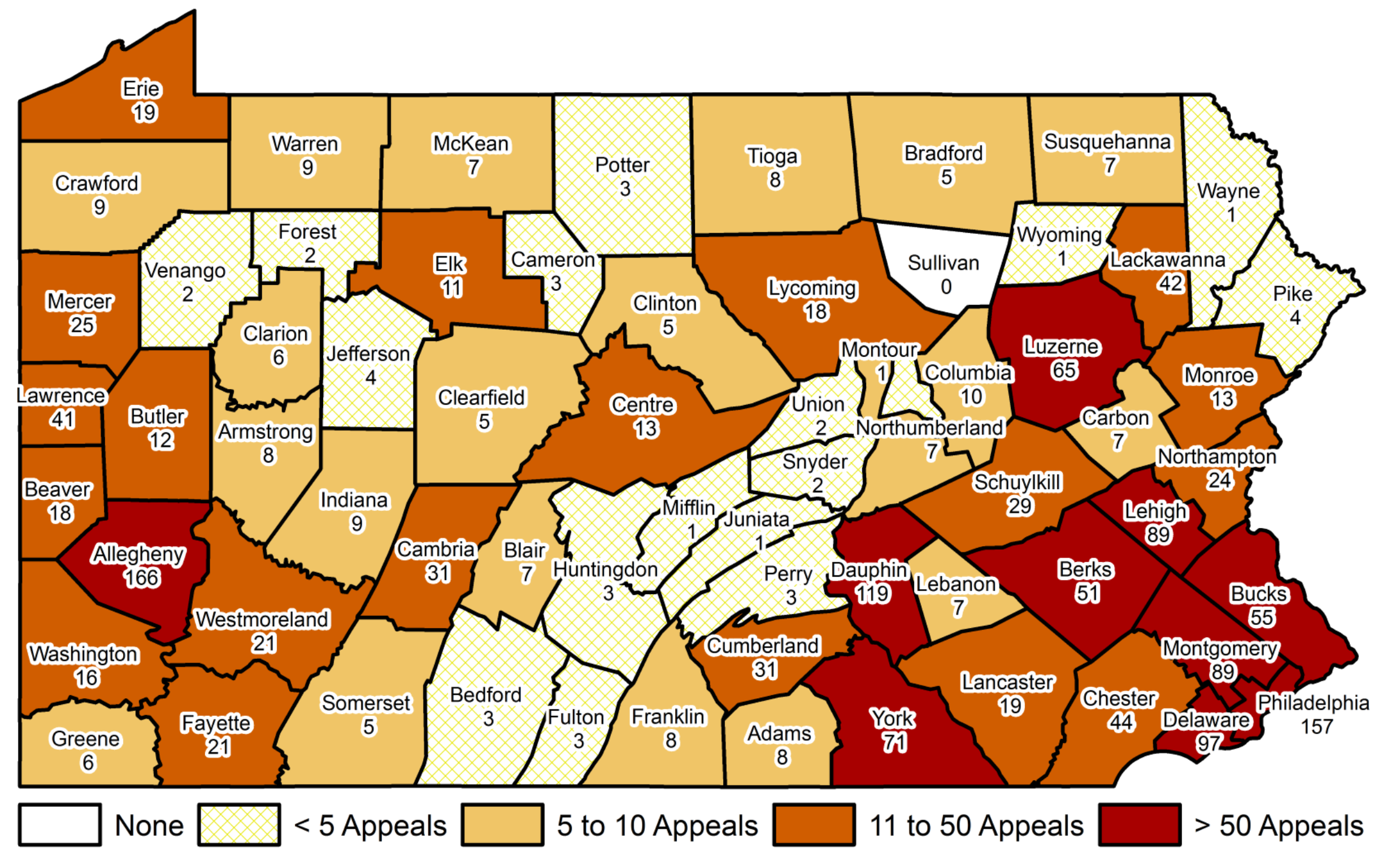
Map: Appeals in 2017 by County

More Right-to-Know Law appeals were filed involving local agencies in Allegheny County — including the county itself, school districts, authorities, municipalities, etc. — than in any other county in 2017. (Allegheny County is home to about 130 municipalities and about 40 school districts.)

The top 10 counties by this measure were:

  • Allegheny, 166
  • Philadelphia, 157
  • Dauphin, 119
  • Delaware, 97
  • Lehigh, 89
  • Montgomery, 89
  • York, 71
  • Luzerne, 65
  • Bucks, 55
  • Berks, 51

2017 - Statewide Map

This map shows the number of non-inmate appeals involving local agencies which were filed with the OOR in 2017. All local agencies (e.g., county government, school districts, municipalities, etc.) are included in each county total.

The top 10 counties by this measure are all among the top 15 most populous counties in Pennsylvania.

This information is from the OOR’s 2017 Annual Report.

Issues Raised by Agencies During RTKL Appeals in 2017

In 2017, for the first time ever, the Office of Open Records tracked the issues raised by agencies and addressed by the OOR’s Appeals Officers during Right-to-Know Law appeals.

This data gives some insight into the reasons most commonly raised by agencies for denying access to records.

Of the 30 exemptions specifically enumerated in Section 708(b) of the RTKL, these 11 were raised most often in 2017:

  • Criminal Investigative Records, (b)(16), 156
  • Noncriminal Investigative Records, (b)(17), 127
  • Personal Identification Information, (b)(6), 104
  • Personal Security, (b)(1), 72
  • Internal, Predecisional Deliberations, (b)(10), 71
  • Public Safety, (b)(2), 65
  • Agency Employee Information, (b)(7), 34
  • Trade Secret / Confidential Proprietary Information, (b)(11), 32
  • Building, Infrastructure and Utility Safety, (b)(3), 29
  • Procurement Prior to Award of Contract, (b)(26), 20
  • Notes and Working Papers, (b)(12), 20

The OOR’s Appeals Officers also heard hundreds of cases in which the agency asserted that the requested records didn’t exist (426), the requested records weren’t in the possession of the agency (184), and the request wasn’t specific enough or asked questions rather than seeking records (117).

Many appeals heard by the OOR involve more than one exemption and/or other reasons for denying access to records.

We will continue to track this data in coming years. Over time, the comparison between years should become a useful tool.

This information is from the OOR’s 2017 Annual Report.

532 Appeals Involving State Agencies in 2017

In 2017, the Department of Corrections was involved in 23.3% of Right-to-Know Law appeals filed against state agencies.

Here’s the complete list:

  • Department of Corrections, 23.3%
  • State Police, 13.7%
  • Department of Environmental Protection, 8.3%
  • Department of State, 7.0%
  • Department of Transportation, 6.2%
  • Department of Health, 5.5%
  • Board of Probation and Parole, 5.1%
  • Department of Human Services, 2.6%
  • Department of Education, 2.1%
  • Department of Labor and Industry, 1.9%
  • Other, 24.4%

This information is from the OOR’s 2017 Annual Report.

1,782 Appeals Involving Local Agencies in 2017

In 2017, municipal governments (cities, boroughs, and townships) were involved in 43.1% of Right-to-Know Law appeals filed against local agencies.

Here’s the complete list:

  • Local Education Agencies, 23.0%
  • Townships, 20.7%
  • Counties, 18.7%
  • Cities, 11.3%
  • Boroughs, 11.1%
  • Police Departments, 6.2%
  • Authorities, 5.1%
  • Fire Departments, 0.8%
  • Other, 3.0%

This information is from the OOR’s 2017 Annual Report.