Presentation to CCAP Solicitors’ Conference

Earlier today, I took part in a discussion about the Right-to-Know Law at the 2018 CCAP Solicitors’ Conference in Harrisburg.

Other participants included attorneys Craig J. Staudenmaier and J. Stephen Feinour from Nauman Smith. The panel was moderated by J. Chadwick Schnee, Berks County’s First Assistant Solicitor.

It was a great discussion, and I very much appreciate the invitation.

The discussion covered a fairly wide variety of topics, but the presentation I prepared focused on the Office of Open Records’ survey of Agency Open Records Officers (AOROs) and the Legislative Budget and Finance Committee’s separate survey of AOROs:

CCAP Solicitors’ Conference – May 4, 2018 – PPTX
CCAP Solicitors’ Conference – May 4, 2018 – PDF

54 Training Sessions in 2017

More than 1,900 people attended official Office of Open Records training sessions in 2017. We traveled the state again, including visits to Charleroi, Doylestown, Grove City, Pittsburgh, Roaring Branch, and Summerdale.

The OOR provides training on the Right-to-Know Law and the Sunshine Act.

We’re back on the road in 2018 — and this year we’ll also be conducting training sessions online.

Our training schedule can be found here.

This information is from the OOR’s 2017 Annual Report.

110 Mediations in 2017

The Office of Open Records conducted 110 Right-to-Know Law mediations in 2017.

Our mediation program can be an effective way to resolve disputes between requesters and agencies. Many of our Appeals Officers are also trained mediators and can conduct mediations via telephone or in person.

When a mediation is successful, the appeal is withdrawn — saving both sides the effort of engaging in a formal appeal process and ensuring that the case never goes to court.

Either side can choose to end mediation at any time; if this happens, the OOR’s traditional appeal process begins.

More about our mediation program can be found here.

This information is from the OOR’s 2017 Annual Report.

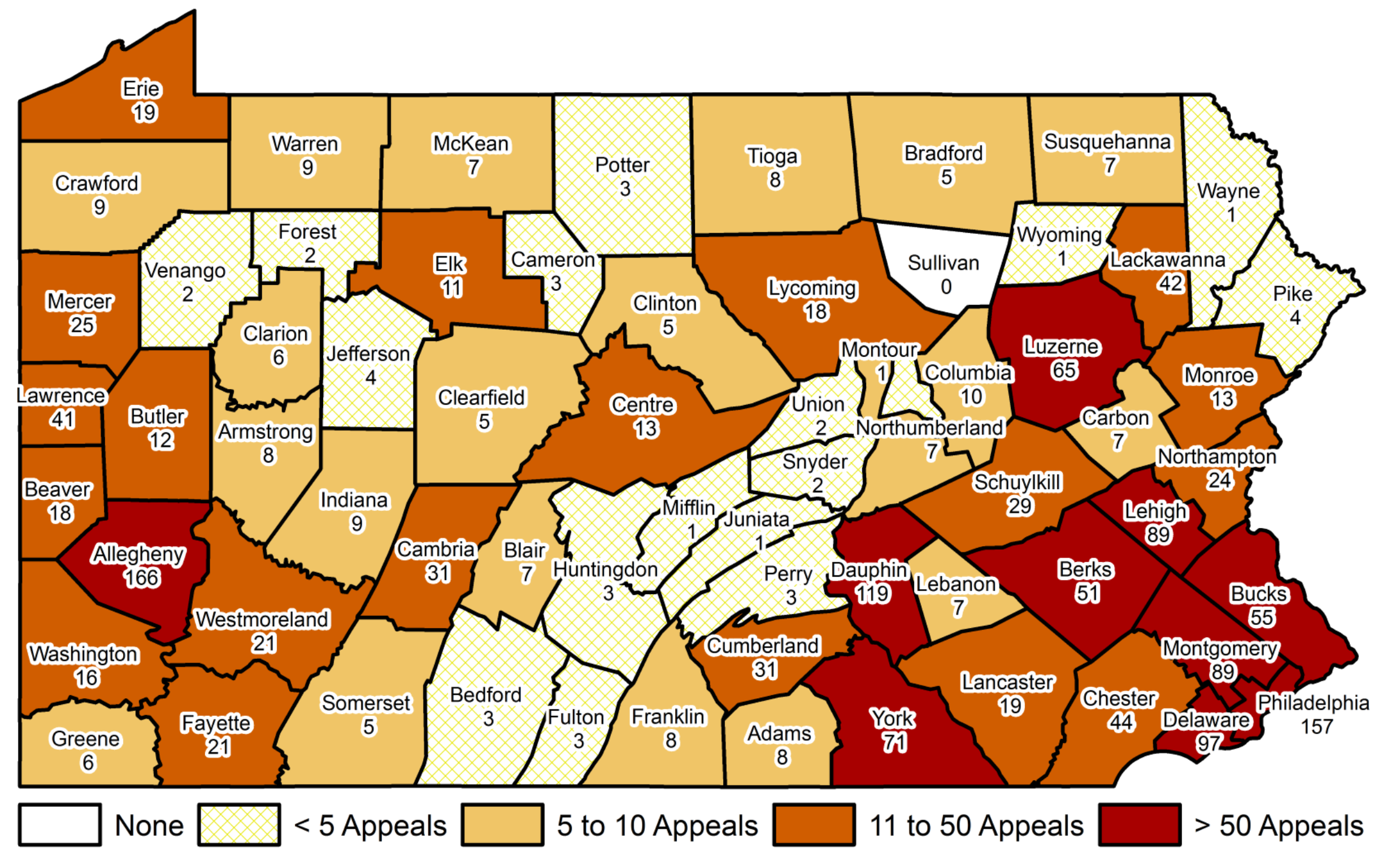
Map: Appeals in 2017 by County

More Right-to-Know Law appeals were filed involving local agencies in Allegheny County — including the county itself, school districts, authorities, municipalities, etc. — than in any other county in 2017. (Allegheny County is home to about 130 municipalities and about 40 school districts.)

The top 10 counties by this measure were:

  • Allegheny, 166
  • Philadelphia, 157
  • Dauphin, 119
  • Delaware, 97
  • Lehigh, 89
  • Montgomery, 89
  • York, 71
  • Luzerne, 65
  • Bucks, 55
  • Berks, 51

2017 - Statewide Map

This map shows the number of non-inmate appeals involving local agencies which were filed with the OOR in 2017. All local agencies (e.g., county government, school districts, municipalities, etc.) are included in each county total.

The top 10 counties by this measure are all among the top 15 most populous counties in Pennsylvania.

This information is from the OOR’s 2017 Annual Report.

Issues Raised by Agencies During RTKL Appeals in 2017

In 2017, for the first time ever, the Office of Open Records tracked the issues raised by agencies and addressed by the OOR’s Appeals Officers during Right-to-Know Law appeals.

This data gives some insight into the reasons most commonly raised by agencies for denying access to records.

Of the 30 exemptions specifically enumerated in Section 708(b) of the RTKL, these 11 were raised most often in 2017:

  • Criminal Investigative Records, (b)(16), 156
  • Noncriminal Investigative Records, (b)(17), 127
  • Personal Identification Information, (b)(6), 104
  • Personal Security, (b)(1), 72
  • Internal, Predecisional Deliberations, (b)(10), 71
  • Public Safety, (b)(2), 65
  • Agency Employee Information, (b)(7), 34
  • Trade Secret / Confidential Proprietary Information, (b)(11), 32
  • Building, Infrastructure and Utility Safety, (b)(3), 29
  • Procurement Prior to Award of Contract, (b)(26), 20
  • Notes and Working Papers, (b)(12), 20

The OOR’s Appeals Officers also heard hundreds of cases in which the agency asserted that the requested records didn’t exist (426), the requested records weren’t in the possession of the agency (184), and the request wasn’t specific enough or asked questions rather than seeking records (117).

Many appeals heard by the OOR involve more than one exemption and/or other reasons for denying access to records.

We will continue to track this data in coming years. Over time, the comparison between years should become a useful tool.

This information is from the OOR’s 2017 Annual Report.

532 Appeals Involving State Agencies in 2017

In 2017, the Department of Corrections was involved in 23.3% of Right-to-Know Law appeals filed against state agencies.

Here’s the complete list:

  • Department of Corrections, 23.3%
  • State Police, 13.7%
  • Department of Environmental Protection, 8.3%
  • Department of State, 7.0%
  • Department of Transportation, 6.2%
  • Department of Health, 5.5%
  • Board of Probation and Parole, 5.1%
  • Department of Human Services, 2.6%
  • Department of Education, 2.1%
  • Department of Labor and Industry, 1.9%
  • Other, 24.4%

This information is from the OOR’s 2017 Annual Report.

1,782 Appeals Involving Local Agencies in 2017

In 2017, municipal governments (cities, boroughs, and townships) were involved in 43.1% of Right-to-Know Law appeals filed against local agencies.

Here’s the complete list:

  • Local Education Agencies, 23.0%
  • Townships, 20.7%
  • Counties, 18.7%
  • Cities, 11.3%
  • Boroughs, 11.1%
  • Police Departments, 6.2%
  • Authorities, 5.1%
  • Fire Departments, 0.8%
  • Other, 3.0%

This information is from the OOR’s 2017 Annual Report.

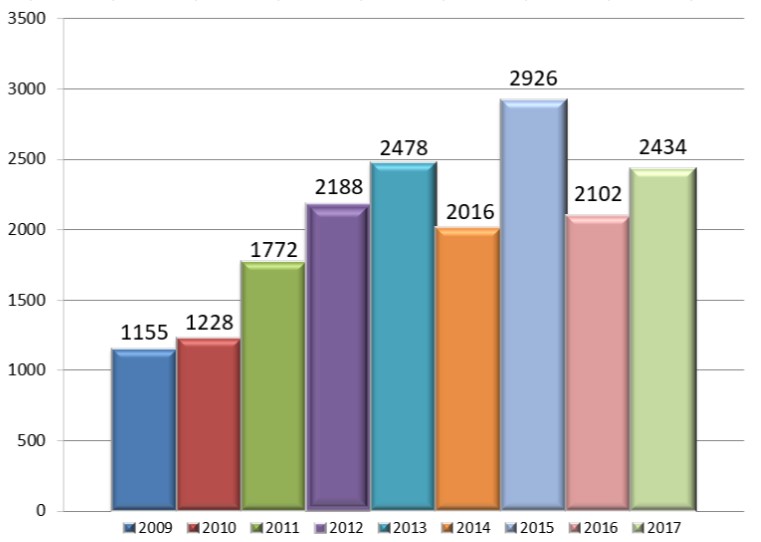
2,434 Appeals Filed in 2017

2017 was the third-busiest year ever for the Office of Open Records in terms of the number of Right-to-Know Law appeals filed. In addition, the appeals continued to grow in complexity, with more sophisticated arguments being made and more nuanced issues being presented in many cases.

Nearly two-thirds (63.5%) of all appeals filed in 2017 were filed by everyday citizens. They were followed by:

  • Inmates, 18.4%
  • Companies, 10.1%
  • Media, 6.3%
  • Government officials, 1.6%

This information is from the OOR’s 2017 Annual Report.

29,746 Pageviews per Month

We’re putting the final touches on the Office of Open Records’ 2017 Annual Report (the full report should be out this week). In the meantime, here’s one statistic that didn’t make the final cut but which may be of some interest.

In 2017, the OOR’s website generated 356,947 pageviews — an average of 29,746 per month.

March was the month with the most pageviews, 33,706.

The five most visited pages were:

New Searchable AORO Database

Last week, the Office of Open Records (“OOR”) launched a searchable online database of Agency Open Records Officer (“AORO”) contact information for every registered agency in the Commonwealth.

The AORO database allows the public to contact the correct AORO to request agency records and ensures that the OOR can contact AOROs in the event an appeal is filed with the OOR.

You can find the database here: http://www.openrecords.pa.gov/RTKL/AOROSearch.cfm