Local & Commonwealth Agency Appeals in 2016

Among local agencies, municipal governments (cities, boroughs, and townships) were involved in the most Right-to-Know Law appeals in 2016: 53%.

If you include local police departments and fire departments, that percentage jumps to 63%.

Local Agency Appeals - 2016 Annual Report

Among commonwealth agencies, the Department of Corrections (38.7%) was involved in more appeals than any other in 2016. The vast majority of DOC appeals were filed by inmates.

The Pennsylvania State Police were involved in 6.8% of commonwealth agency appeals, followed by the Dept. of Transportation (5.9%), the Dept. of Environmental Protection (5.9%), the Board of Probation and Parole (3.8%), the Dept. of Human Services (3.1%), the Philadelphia Parking Authority* (3.0%), and the Dept. of State (2.8%).

Commonwealth Agency Appeals - 2016 Annual Report

* The Philadelphia Parking Authority is a commonwealth agency pursuant to the statute which created it.
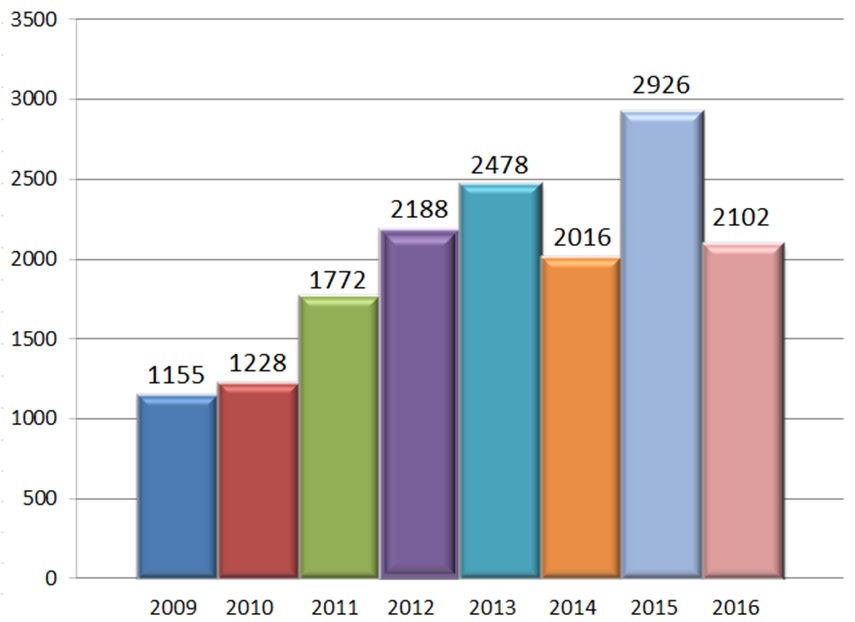
2,102 Appeals Filed with the OOR in 2016

The number of appeals filed in 2016 declined from 2015’s record-setting pace, but the complexity of issues presented in the cases continued to grow.

Over the past five years, the average number of cases heard by the OOR is 2,342.

Predictions are dangerous, especially when they’re printed in an annual report (and on this blog) where anyone can refer back to them very easily, but… I predict the number of cases over the next several years will remain between 2,000 and 2,500 per year.

Appeals by Year - 2016 Annual Report

Highlights from the OOR’s 2016 Annual Report

The Office of Open Records’ Annual Report for 2016 is now available. I enjoy putting together these reports and think they provide good insight into how the Right-to-Know Law is working across Pennsylvania.

Highlights from this year’s report include:

  • 2,102 appeals were filed with the Office of Open Records in 2016. Of those, more than half (1,077) were filed by everyday citizens.
  • 1,424 appeals involved local agencies; 573 involved state agencies. (The remainder involved agencies over which the OOR does not have jurisdiction.)
  • 70 training sessions were conducted across the state and attended by about 3,000 people, including public officials, agency employees, and requesters.
  • 49 successful mediations were achieved, which help both agencies and requesters by ensuring that the appeals do not move to court.

I’ll be highlighting more of this year’s Annual Report in subsequent posts to this blog.

Past Annual Reports are available here.

Presentation at Sunshine Week CLE

Open records_logo stackedEarlier today, I was part of a panel discussion at a CLE hosted by the Pennsylvania NewsMedia Association at Widener Law Commonwealth in Harrisburg.

It was an excellent event (even if last week’s snow did push it into the week after Sunshine Week!), and I appreciate the invitation to participate.

Here’s the presentation I used:

PNA Sunshine Week CLE at Widener – March 21, 2017 – PDF
PNA Sunshine Week CLE at Widener – March 21, 2017 – PPTX

Presentation at Body-Worn Cameras CLE

Open records_logo stackedOn Friday, I took part in Forensic Friday, a regular program organized by Duquesne University’s Cyril H. Wecht Institute of Forensic Science and Law.

The topic was Balancing Safety, Justice and Privacy: Body-Worn Cameras, Forensic Evidence & the Right to Know.

Also taking part in the program were State Senator Randy Vulakovich; State Representative Dom Costa; former State Representative David Mayernik; Commander Clarence Trapp, head of the Pittsburgh Bureau of Police’s Special Deployment Division; and Duquesne University School of Law Professor John Rago.

It was a great event and a great discussion, and I very much appreciate the invitation to participate.

Here’s the presentation I used:

Body-Worn Cameras CLE – Jan. 27, 2017 – PDF
Body-Worn Cameras CLE – Jan. 27, 2017 – PPTX

Body-Worn Cameras, Forensic Evidence & the Right to Know

Forensic Fridays LogoOn Friday, January 27, I’ll be taking part in Forensic Friday, a regular program organized by Duquesne University’s Cyril H. Wecht Institute of Forensic Science and Law.

The topic is Balancing Safety, Justice and Privacy: Body-Worn Cameras, Forensic Evidence & the Right to Know.

Also part of the program are State Senator Randy Vulakovich; State Representative Dom Costa; former State Representative David Mayernik; Commander Clarence Trapp, head of the Pittsburgh Bureau of Police’s Special Deployment Division; and Duquesne University School of Law Professor John Rago, who has been working closely with state legislators to develop legislation governing the use of body-worn cameras.

The program is scheduled for 1:00 p.m. to 4:30 p.m. and is approved by the Pennsylvania CLE Board for 3 hours of substantive CLE credit, by the University of Pittsburgh School of Social Work for 3 hours of Social Work credit, and by the Pennsylvania Coroners Education Board for 1 hour of Coroners Education credit.

Here’s a fuller description from the University:

Continue reading

Presentation to Doylestown Intelligencer

Open records_logo stackedYesterday, George Spiess (Chief of Training & Outreach for the Office of Open Records) and I had the opportunity to discuss the Right-to-Know Law and the Office of Open Records with employees of the Doylestown Intelligencer. We very much appreciate the invitation.

Here’s the presentation we used:

Doylestown Intelligencer – Jan. 18, 2017 – PDF
Doylestown Intelligencer – Jan. 18, 2017 – PPTX

How to Find Government Contracts in Pennsylvania

Open records_logo stackedAt least one state has recently considered legislation which would make it harder for the public to review contacts involving government agencies.

Here in Pennsylvania, the Right-to-Know Law makes all state government contracts valued at $5,000 or more easy to review online.

The state contract database is maintained by the state Treasurer, and it allows anyone with Internet access to search contracts by agency, contracting party, date range, and more.

Contracts involving local agencies like counties, school districts, cities, boroughs, and townships are not included in the database — but those are generally available by filing a simple Right-to-Know Law request.

Updating the Standard RTK Request Form

Open records_logo stackedPennsylvania’s Right-to-Know Law gives the Office of Open Records the duty to “develop a uniform [request] form which shall be accepted by all Commonwealth and local agencies” (Section 505(a)).

The OOR’s standard Right-to-Know request form hasn’t been updated since 2013. We’re now in the process of reviewing and updating the form — with the goal of improving it by making it better for both requesters and agencies.

Previous version of the form can be found here:

(Here’s a direct link to download a PDF of the current version.)

If you have any thoughts or suggestions on how to improve the standard RTK request form, please share them with us. We’d love to hear from you.

(In addition to the OOR’s contact form, feel free to leave comments on this blog or on Twitter.)